
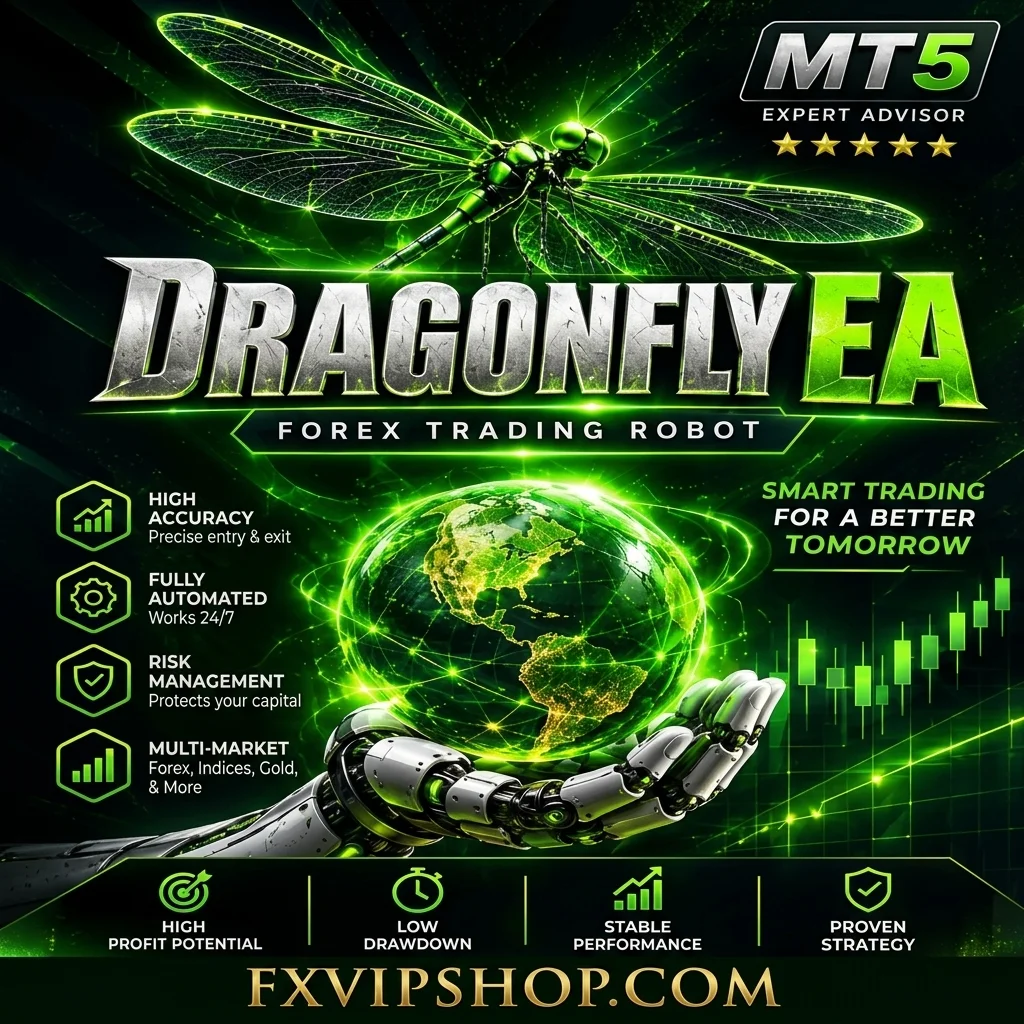
Description
DragonFly EA MT5 Review
Finding a Forex EA that can handle more than simply opening and closing trades is difficult.
Many automated trading systems concentrate heavily on entries while giving less attention to what happens when several positions are already open.
That is where DragonFly EA MT5 caught my attention.
The system is presented as a multi-pair MetaTrader 5 Expert Advisor with centralized trade management, dynamic hedging, drawdown monitoring, currency exposure controls, ATR-based management, trailing stops, break-even functionality, and dynamic lot sizing.
However, more features do not automatically mean better trading results.
So, in this DragonFly EA MT5 review, I’m looking beyond the marketing and focusing on how the system is structured, where it may fit, and what risks traders should understand before going live.
➡️ Telegram: Join For NEW Updates & Settings
➡️ Vendor’s Website: Here
What Is DragonFly EA MT5?
DragonFly EA MT5 is an automated Forex trading system designed for MetaTrader 5.
Its main selling point appears to be portfolio-level trade management, rather than relying on a single simple entry technique.
The product information also identifies M15 as the primary recommended timeframe.
This is worth noting because the supplied specifications describe several timeframes and user-selectable major/cross pairs. The published product page I found is more specific, so I would verify the exact version and settings included with your purchase before publishing a fixed configuration as fact.
My Testing Experience
I don’t want to invent backtest or live-account results and call them my own.
Instead, my assessment here is based on the documented DragonFly EA MT5 functionality and the way those components would interact in real Forex conditions.
What immediately stands out is the emphasis on account-level management.
A normal trader may look at EURUSD, GBPUSD and USDCHF as three separate trades. But from a risk perspective, they can create substantial overlapping exposure to the US dollar.
DragonFly’s currency-exposure and global-drawdown approach appears designed to look at that bigger picture rather than treating every position independently.
That is a sensible concept.
However, it also means the EA should not be judged solely by its winning-trade percentage. Margin usage, simultaneous positions, correlation and drawdown behavior matter just as much.
One limitation I would watch closely is the interaction between multiple pairs during highly correlated market movements.
Trading Strategy Explained Simply
The EA appears to combine automated trading with broader position-management logic.
Rather than relying on one feature, its framework includes:
- Multi-pair trading
- Trade and currency exposure monitoring
- Dynamic hedging
- Global drawdown monitoring
- ATR-based management
- Dynamic position sizing
- Break-even and trailing-stop management
ATR, or Average True Range, is particularly useful for measuring market volatility. It does not predict whether price will rise or fall, but it can help an automated system adapt certain management parameters to changing volatility.
The EA also includes functionality intended to control trading around important market conditions.
That matters because spreads, liquidity and execution can change dramatically around major economic announcements.
Key Features
✅ Multi-pair Forex trading — Designed to manage several major currency pairs.
✅ Global drawdown monitoring — Looks beyond individual positions and considers broader account conditions.
✅ Dynamic hedging — Provides configurable hedging functionality.
✅ Currency exposure management — Useful when several trades share the same underlying currency.
✅ ATR-based management — Adds a volatility-aware element to trade management.
✅ Dynamic lot sizing — Position size can be adjusted according to configured account and risk conditions.
✅ Trailing stop and break-even tools — Automates parts of ongoing position management.
✅ Custom alerts — Helps traders monitor account and trading conditions without watching MT5 continuously.
DragonFly EA MT5 Specifications
| Specification | Details |
| Platform | MetaTrader 5 |
| Account Type | Standard/ECN/STP depending on broker compatibility |
| Currency Pairs | EURUSD, GBPUSD, USDJPY, USDCHF, USDCAD, AUDUSD, NZDUSD |
| Recommended Timeframe | M15 |
| Recommended Minimum Deposit | Supplied specification: $100; published product information: $1,000 suggested |
| Recommended Leverage | Not clearly specified |
| Broker Environment | ECN/STP recommended |
| Live Operation | Possible, but demo/forward testing is strongly recommended |
| VPS | Recommended |
| License | Unlimited account |
| Updates | Free lifetime updates according to supplied specifications |
Important: There is a meaningful difference between the supplied $100 recommendation and the currently published $1,000 suggested balance. The published product page also suggests $4,000 when trading all supported pairs.
For that reason, I would not market DragonFly as a $100 live-account EA without additional evidence.
Performance Observations
I would be cautious about judging DragonFly EA MT5 using a single profitability number.
The more interesting question is how it behaves when several positions are active simultaneously.
A multi-pair EA can generate more opportunities, but it can also create concentrated exposure when currencies move together.
The centralized management approach is therefore potentially one of the stronger aspects of the system.
On the other hand, hedging and additional positions can increase transaction costs and margin requirements. Hedging reduces certain directional exposures, but it does not eliminate trading risk.
Broker execution will also matter.
Spreads, commissions, slippage, stop-level restrictions and liquidity can all influence the results of an automated trading system.
Risk Management & Drawdown Analysis
This is probably the section I would pay the most attention to before using DragonFly on a live account.
The EA includes several tools that are relevant to risk management, including global drawdown monitoring, dynamic lot sizing, currency exposure controls, ATR-based management and hedging.
That is encouraging, but sophisticated risk-management features are not the same thing as low risk.
Potential problems include:
- Multiple correlated trades
- Sudden market gaps
- Spread expansion
- Slippage
- High-impact news
- Excessive leverage
- Margin pressure
- VPS or connection failures
- Unexpected broker execution
- Prolonged directional trends
I would therefore start with conservative settings and run the EA on a demo account before risking meaningful capital.
Pros and Cons
Pros
- Multi-pair MT5 approach
- Portfolio-level trade management
- Global drawdown monitoring
- Dynamic hedging functionality
- Currency exposure controls
- ATR-based management
- Dynamic lot sizing
- Trailing stop and break-even tools
- Suitable for traders wanting less manual intervention
Cons
- More positions can mean more combined exposure
- Hedging does not remove risk
- Broker execution can materially affect results
- Multi-pair trading requires adequate margin
- Published deposit recommendations need clarification
- No automated system can guarantee profits
Who Should Use DragonFly EA MT5?
I would consider it more suitable for traders who:
- Understand basic Forex risk management
- Prefer automated MT5 systems
- Want multi-pair exposure
- Understand correlation between currency pairs
- Can monitor margin and drawdown
- Are comfortable forward-testing an EA
- Have access to a reliable VPS
It may particularly appeal to traders who want an automated trading system with more emphasis on portfolio management than simple entry signals.
Who Should Avoid It?
I would be cautious if you are completely new to Forex or expect an EA to operate without supervision.
I would also avoid using aggressive lot sizes simply because the account balance is small.
The multi-pair structure makes risk management especially important. A trader who does not understand correlated exposure could easily underestimate the actual risk in the account.
Installation & Setup Guide
Getting started with DragonFly EA MT5 is relatively straightforward:
- Install MetaTrader 5 with a compatible broker.
- Copy the EA files into the appropriate MT5 directories.
- Restart MT5 or refresh the Navigator.
- Attach DragonFly EA MT5 to the recommended chart/timeframe.
- Configure pairs, risk and trade-management settings.
- Enable automated trading.
- Run a demo or forward test before moving to a live account.
A VPS is also worth considering if the EA is intended to operate continuously.
My Opinion After Reviewing DragonFly EA MT5
DragonFly EA MT5 is interesting because it does not appear to focus exclusively on finding entries.
Its stronger proposition is the combination of multi-pair automation and centralized risk/trade management.
That makes it different from many simpler Forex robots.
However, I would not call it a low-risk EA simply because it contains several risk-management features. The combination of multiple currency pairs, hedging, leverage and automated position sizing still requires careful configuration.
My recommendation would be to test it first with your own broker, realistic spreads and conservative risk settings.
If the forward-test results remain consistent and the account-level drawdown fits your tolerance, DragonFly EA MT5 is certainly worth considering for traders looking for a structured MT5 multi-pair system.
FAQs
01. Is DragonFly EA MT5 suitable for beginners?
It can be operated automatically, but beginners should understand leverage, margin, drawdown and currency correlation before using it with real money.
02. What timeframe does DragonFly EA MT5 use?
The currently published product information identifies M15 as the recommended timeframe.
03. Which currency pairs does DragonFly EA MT5 support?
The published information lists EURUSD, GBPUSD, USDJPY, USDCHF, USDCAD, AUDUSD and NZDUSD.
04. Does DragonFly EA MT5 use hedging?
Yes. The published product description includes configurable dynamic hedging functionality.
05. Does DragonFly EA MT5 guarantee profits?
No. Like every automated Forex trading system, it can experience losing trades and drawdowns. Past or simulated performance should never be treated as a guarantee.
06. How much money do I need for DragonFly EA MT5?
The supplied specification mentions $100, but the current published product information suggests $1,000 and recommends $4,000 for all supported pairs. I would use the latter figures as the more conservative reference until the exact product version confirms otherwise.
07. Should I use a VPS with DragonFly EA MT5?
A VPS is recommended for continuous operation because it can help keep MetaTrader 5 running when your personal computer is offline.
👉 Reviewed By: Michael Harrington
Direct Contact And More EAs
- Direct Contact- Telegram: FXVIPShop Support

Reviews
There are no reviews yet.